
Exchange spaces between parents are plentiful on paper. Their actual quality depends on parameters that most parenting guides overlook: facilitation format, the posture of the lead professional, adaptation to atypical family profiles. We observe that the structuring of these systems has significantly evolved in recent years, particularly under the influence of the Public Service for Early Childhood and the so-called “outreach” approaches.
Support for parents of children with specific needs: a blind spot being corrected
Classic discussion groups target a general parenting approach. Parents of sick, disabled, or neurodevelopmentally challenged children rarely find themselves there. Their isolation is documented: in Merlevenez, a diagnosis conducted in 2024 led to the establishment of a bimonthly appointment dedicated to these families, in an explicitly non-judgmental setting.
This type of system remains marginal. Most child-parent reception places (LAEP) or parent cafés do not segment their audiences. The result: exchanges where issues of disability or behavioral disorders are addressed on the margins, when they are not avoided due to collective embarrassment.
We recommend that concerned parents check with their departmental CAF or via monenfant.fr if specific slots exist locally. The availability remains very uneven across territories, with a marked gap between urban and rural areas. The presentation of the Douceur Enfance site allows for the identification of complementary resources aimed at daily parental support.
Facilitation formats: what distinguishes a useful discussion space from a simple informal café

A parent exchange space is not just a room and a coffee maker. The facilitation framework directly conditions the quality of interactions. Three technical parameters deserve particular attention.
- Facilitator’s posture: a trained professional (specialized educator, psychologist, marital and family counselor) ensures a safe environment. They stop exchanges that go beyond the collective perimeter and guide individuals if necessary, without exposing the parent in front of the group.
- Regularity of the slot: a monthly or bimonthly fixed appointment creates group dynamics. Occasional formats (annual forum, isolated conference) generate few lasting connections among participants.
- Explicit confidentiality rule: the most effective spaces set an oral framework at the beginning of the session, reminding that what is said in the group stays in the group. Without this rule, speaking on sensitive topics (violence, addiction, educational difficulties) remains superficial.
Thematic workshops (collective cooking, video game experimentation, sophrology) serve as pretexts for exchange. They lower the entry barrier for parents who do not see themselves in a classic discussion group. The content of the activity matters less than the atmosphere it creates.
“Outreach” approaches in parenting: reaching families outside of institutions
The most isolated families do not enter institutions. This observation, shared by field professionals, has led to the development of outreach programs. The principle: move the support offer to where families live, rather than waiting for them to come to a dedicated location.
These approaches take various forms depending on the territories: mobile offices in priority neighborhoods, interventions during school times (breakfasts at school, class outings), presence at markets or in community centers. The challenge is not only geographical. It is also about removing symbolic barriers that prevent some parents from seeking support.
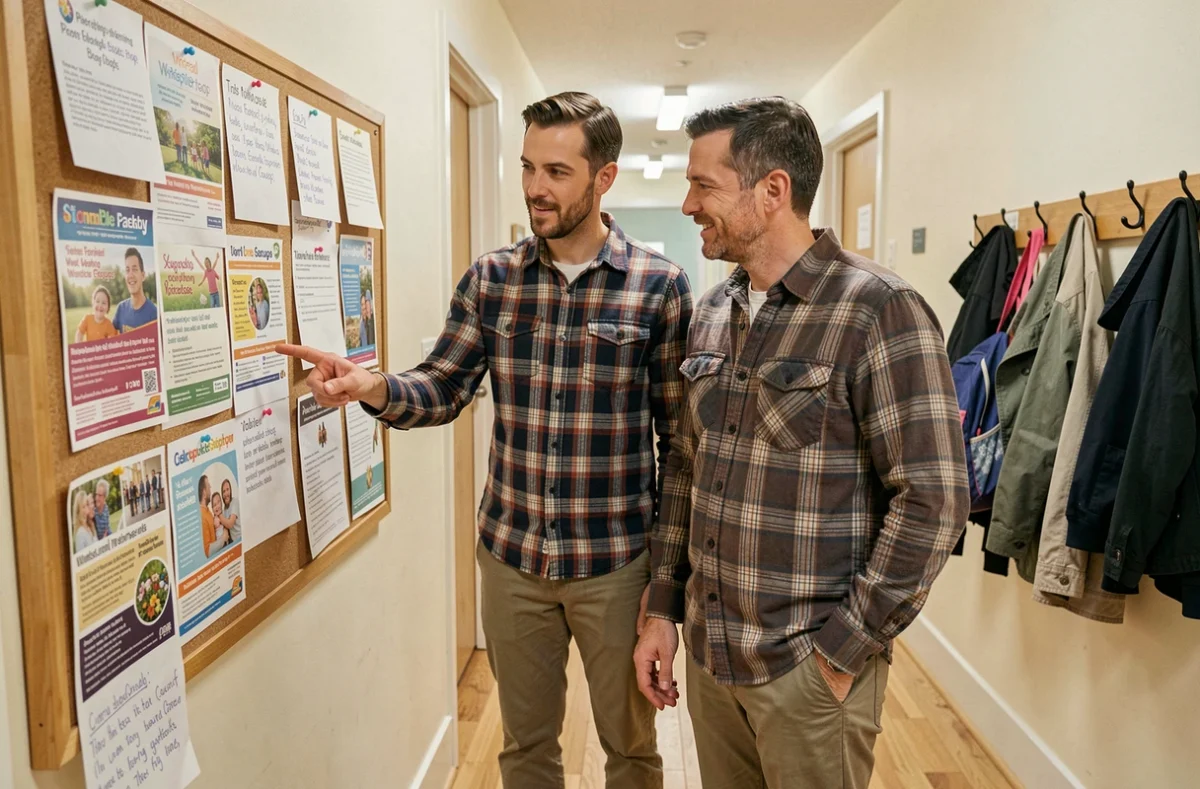
The Public Service for Early Childhood, whose gradual implementation is changing local governance, reinforces this logic. Municipalities are becoming coordinators of parental support offers in their territories. For example, Grenoble has opened a new child-parent reception place (LAEP) called “À petits pas,” which is part of this dynamic.
Online resources and digital spaces for parental support
Digital platforms complement the physical offer without replacing it. They meet a specific need: access to peer advice outside institutional hours, in the evening, on weekends, or during insomnia related to parental stress.
The CAF offers a listening service dedicated to parents, focused on identifying their support needs. Monenfant.fr remains the reference portal for locating physical structures department by department. Other associative resources complement the network: the Restos du Coeur now includes a family component in their actions, combining peer exchange, guidance, and material assistance.
We observe that the most useful digital spaces combine a moderated forum and a geolocated directory. A discussion space without orientation towards local professionals quickly goes in circles. Conversely, a simple directory without a community dimension does not retain parents seeking connection.
Criteria for evaluating a parent exchange space
Before committing to a parenting group or workshop, a few verification points can save time.
- Is the facilitator a qualified professional or a trained volunteer? This distinction affects the ability to manage crisis situations or sensitive revelations.
- Is the group open (free entry at each session) or closed (same participants over a cycle)? Closed groups foster trust, while open groups promote accessibility.
- Is the location neutral (neither school, nor PMI, nor court)? A setting perceived as institutional hinders free speech, especially for parents in conflict with an administration.
- Does the system offer individual follow-up in case of needs identified during the collective session?
Parental support is gaining diversity in formats and territorial coverage, but quality remains linked to the training of facilitators and the regularity of appointments. Parents seeking an exchange space suited to their situation should test several systems before settling into a routine, prioritizing those that establish an explicit framework from the first session.