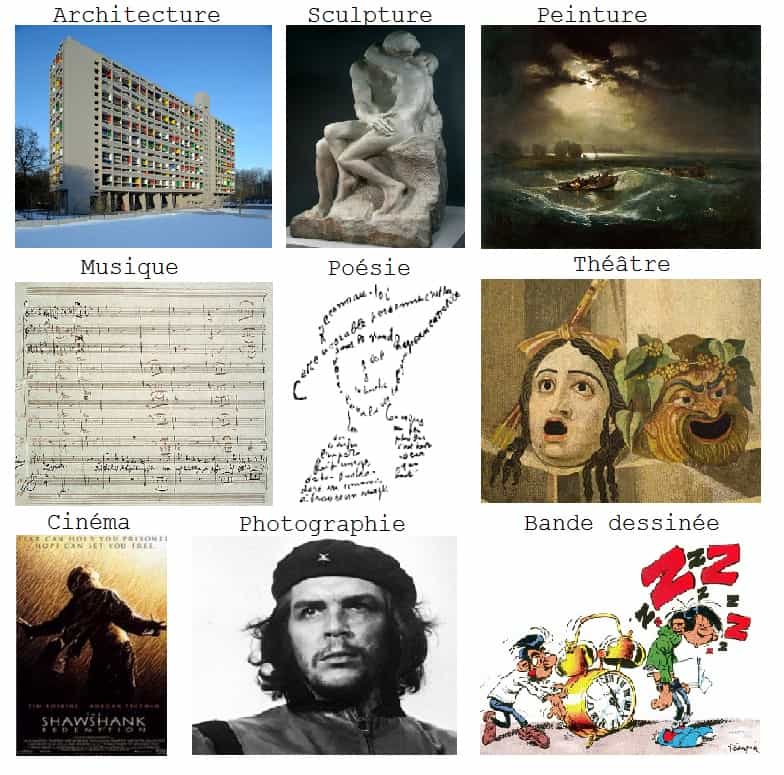
The 9 Major Arts
Since ancient times, man has sought to classify and categorize the arts. Major or minor? It is difficult to define what is and what is not artistic. Sometimes nine arts are highlighted, sometimes seven arts.
Through this article, discover the evolution of the classification of the arts through the ages, their synthesis in a table, their illustration in a schematic image, and as a bonus, an anthology video at the bottom of the page!
eloquence and epic poetry (Calliope), history (Clio), lyric and choral poetry (Erato), music (Euterpe), tragedy (Melpomene), rhetoric (Polymnia), dance and choral singing (Terpsichore), comedy (Thalia) and astronomy in ancient Greek times, there was an agreement to speak of nine arts, linked (or inspired by) nine muses. As a reminder, the muses are the daughters of the Polish Zeus and our dear goddess of memory Mnemosyne (hence the words mnemonic, mnemonic, mnemonic, mnemonic, yeah!) come from. The nine arts sponsored by the muses were respectively, and at the time, (Urania).
The muses inspire these arts, very focused on letters, music, and the performing arts. Currently, construction activities (such as architecture), representative or visual (sculpture, drawing, etc.) are not considered artistic.
In the Middle Ages, the arts sciences were not distinguished. This group of knowledge and achievements was intertwined in two educational modules called trivium and quadrivium constituting the liberal arts. The trivium has three disciplines: rhetoric, grammar, and dialectic. This group of knowledge is intended for the arts of language. The quadrivium includes four disciplines: arithmetic, geometry, astronomy, and music. This group is intended for the learning of number sciences.
In addition to the liberal arts, there are mechanical arts that relate to activities that transform a material by artists or craftsmen. In this group are architecture, sculpture, painting, goldsmithing as well as drapery, iron and steel, glassware, cutlery, and grocery.
Until the 19th century, the arts continued to be inscribed, sometimes according to trades, sometimes according to their nature and signature (an artist is someone who signs their work in the Renaissance). The German philosopher Hegel decided to classify the arts according to criteria: those of expressiveness and materiality. He drew up a list ranging from the least expressive but most material to the most expressive but least material art: architecture, sculpture, painting, music, and poetry.
In the 20th century, four arts were added to this list to form the nine major arts that we know today, like the nine muses of antiquity.
| Number | Type |
|---|---|
| 1st art | Architecture |
| 2nd art | Sculpture |
| 3rd art | Visual arts (painting and drawing) |
| 4th art | Music |
| 5th art | Literature and poetry |
| 6th art | Performing arts (theater, dance, mime, circus) |
| 7th art | Cinema |
| 8th art | Media arts (television, radio, photography) |
| 9th art | Comics |
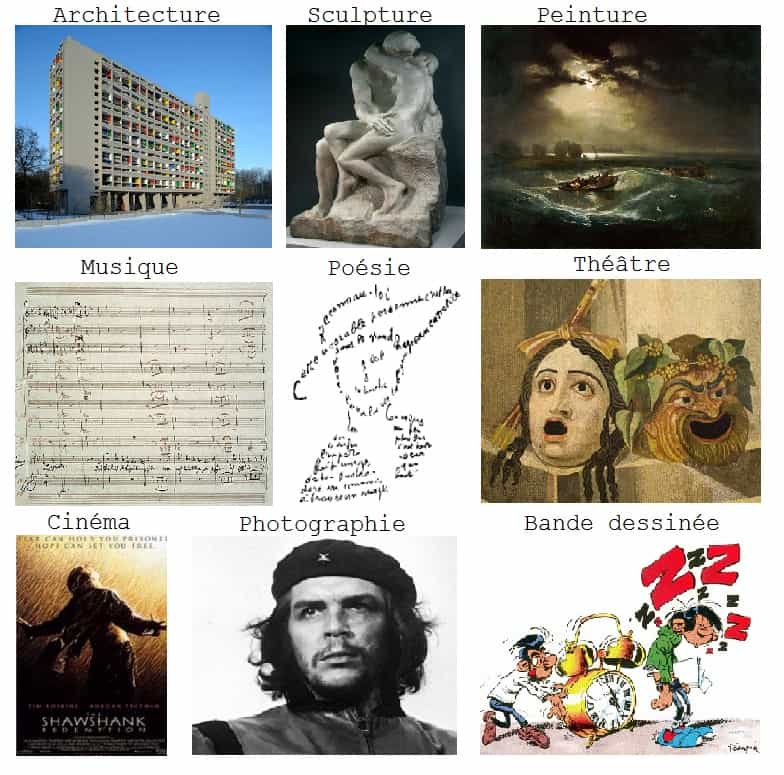 From left to right and top to bottom: The Radiant City by Corbusier (Architecture), Rodin’s Kiss (sculpture), Turner Sea Fishermen (painting), Mozart’s Magic Flute (Music), Do You Recognize Apollinaire (Poetry), Masks of Tragedy and Comedy (Theater), Shawshank Redemption by Frank Darabont, Portrait of Che Guevara by Alberto Korda (Photography), Gaston Lagaffe by Franquin (Comics).
Serge Gainsbourg and No consensus has yet been found to add a tenth art. Moreover, the notion of art is not always unanimous! As a side note, let’s recall the lively exchange between Guy Béart around the song, considered by Gainsbourg as a minor art because it does not require initiation. To review this moment from the anthology, here is the archived VideoParl’ina:
Save
Save
Save
Save
Tag: understanding the major arts