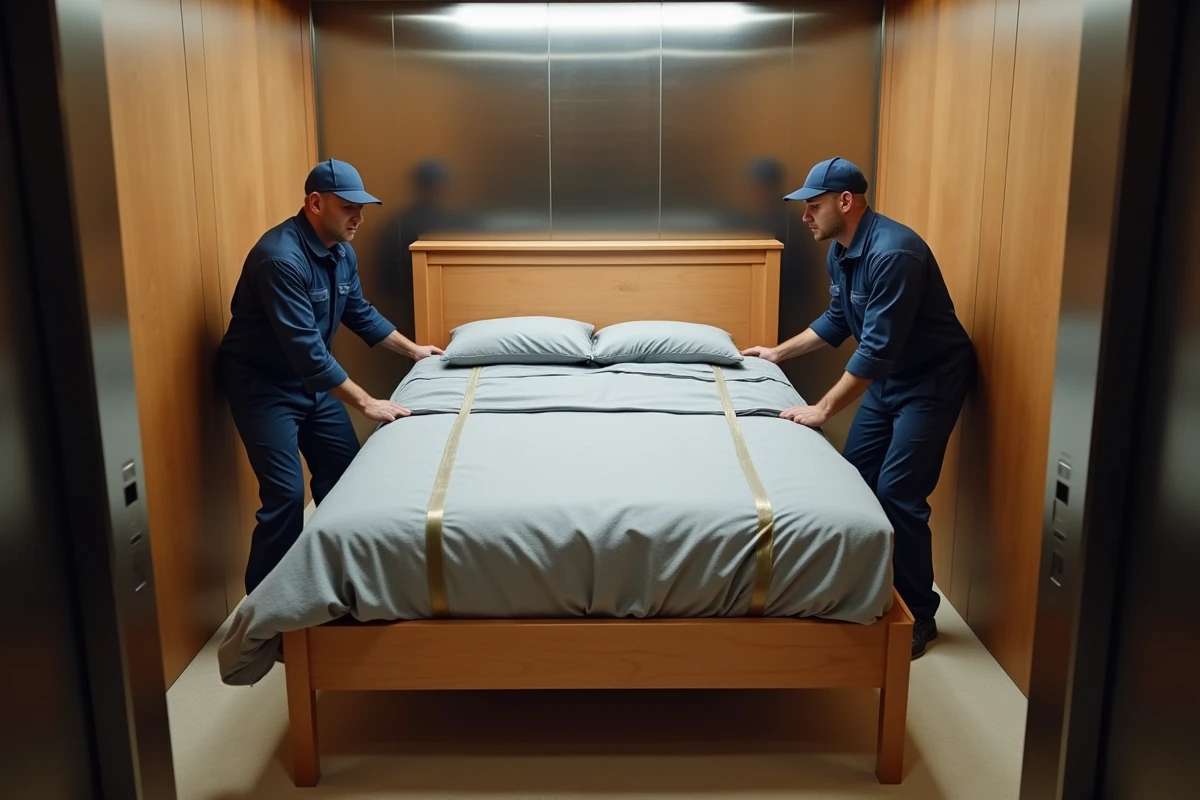
A standard bed base of 140×190 cm measures, once packaged, wider than the cabin of most French residential elevators. The usable width of these cabins often falls below 90 cm, making the transport of a monobloc double bed base physically impossible without tilting, folding, or splitting it. Choosing the right dimensions before purchase prevents a blockage on delivery day.
Usable width of a residential elevator and dimensions of a bed base
The initial constraint is not the size of the bed, but that of the cabin. In recent collective housing, elevator manufacturers (Otis, Schindler, Kone) offer cabins optimized for one person and a wheelchair. The usable interior width often remains below 90 cm, with a depth that varies more significantly.
A 90×190 bed base fits easily in these cabins. A 140×190 bed base in one piece does not fit, even diagonally, as soon as the cabin depth is limited. Knowing the standard dimensions for a bed base helps anticipate this type of blockage before ordering.
Before any purchase, the measurements to take are simple: width, depth, and height of the elevator cabin, then width and height of each door (landing and cabin). A tape measure and two minutes are enough. Measure the cabin, not the door: the door is almost always narrower than the interior space.

Two-part bed base: the format that fits everywhere
Several French manufacturers offer large sizes in two joined bed bases rather than one single block. The principle: two identical half-bed bases, placed side by side on the bed frame, form a single sleeping surface once covered with a mattress.
The most common formats work as follows:
- 140×190 sleeping surface: two bed bases of 70×190, each narrow enough to fit in a standard elevator or a narrow staircase.
- 160×200 sleeping surface: two bed bases of 80×200, a format that has become a standard in mid-range and high-end lines in France.
- 180×200 sleeping surface: two bed bases of 90×200, which fit easily in almost all residential cabins.
This joinable format does not compromise comfort. With a mattress placed on top, the central junction is imperceptible. The two-part bed base has become a de facto standard for transport in buildings, not a second-choice compromise.
Flat-pack bed base or folding bed base: when the joined format is not enough
Some older buildings have multiple obstacles: narrow elevator (or none), spiral staircase, low landing doors. In these cases, even a half-bed base of 70×190 can pose a problem due to its length.
Flat-pack bed base to assemble on-site
The flat-pack bed base arrives in separate parts in small-sized boxes. The frame, slats, and legs are assembled directly in the room. This format fits in any elevator and any staircase.
Assembly usually takes less than half an hour. The robustness depends on the fixing system: prefer metal-on-metal assemblies rather than simple wooden fittings, which can loosen over time.
Folding bed base
The folding bed base folds in two or three along its length, which halves its bulk. Once unfolded and locked, it functions like a traditional slatted bed base. This format is well-suited for studios or temporary housing, but check the locking system: a poorly locked folding bed creaks and moves.

Slatted bed base, spring bed base, or upholstered bed base: the type changes the bulk
The type of bed base directly influences its thickness and rigidity, thus its ability to pass through a tight angle or a narrow door.
A slatted bed base (without an upholstered frame) is the thinnest and lightest. Its thickness is around a few centimeters, making it easier to handle in a confined space. It combines well with the flat-pack or joined format.
An upholstered bed base, covered with fabric on a wooden frame, adds several centimeters of thickness and a significantly higher weight. The spring bed base, even thicker, is also the most rigid: it cannot be folded or bent to negotiate a tight turn.
For transport in an elevator or narrow staircase, the flat-pack slatted bed base remains the safest choice. The upholstered bed base may be suitable in a joined version. The monobloc spring bed base is reserved for homes with ground-level access or on the ground floor.
Checks before ordering: the measurements to take
Taking the dimensions of the elevator is not enough. The complete route from the delivery truck to the room has several potential bottlenecks.
- Building entrance door: often wider than the elevator, but sometimes equipped with a single narrow opening.
- Elevator cabin door: measure in width AND height, as some bed bases are transported standing up.
- Inside the cabin: width, depth, ceiling height, and position of the handrail that reduces the usable space.
- Apartment entrance door and hallway leading to the room: a 90-degree angle in a narrow hallway blocks a rigid bed base longer than 190 cm.
Note these measurements before ordering. Most bed base returns are related to access issues, not product defects.
The most reliable reflex remains to compare the smallest dimension of the chosen bed base (its width) to the smallest opening along the route. If the width of the bed base exceeds this opening, switch to the joined format or the flat-pack. A delivered bed base that does not fit incurs return costs and an additional delay that proper measurement would have avoided.